
Why Timed Practice Alone Won't Improve SAT Reading
Mar 03, 2026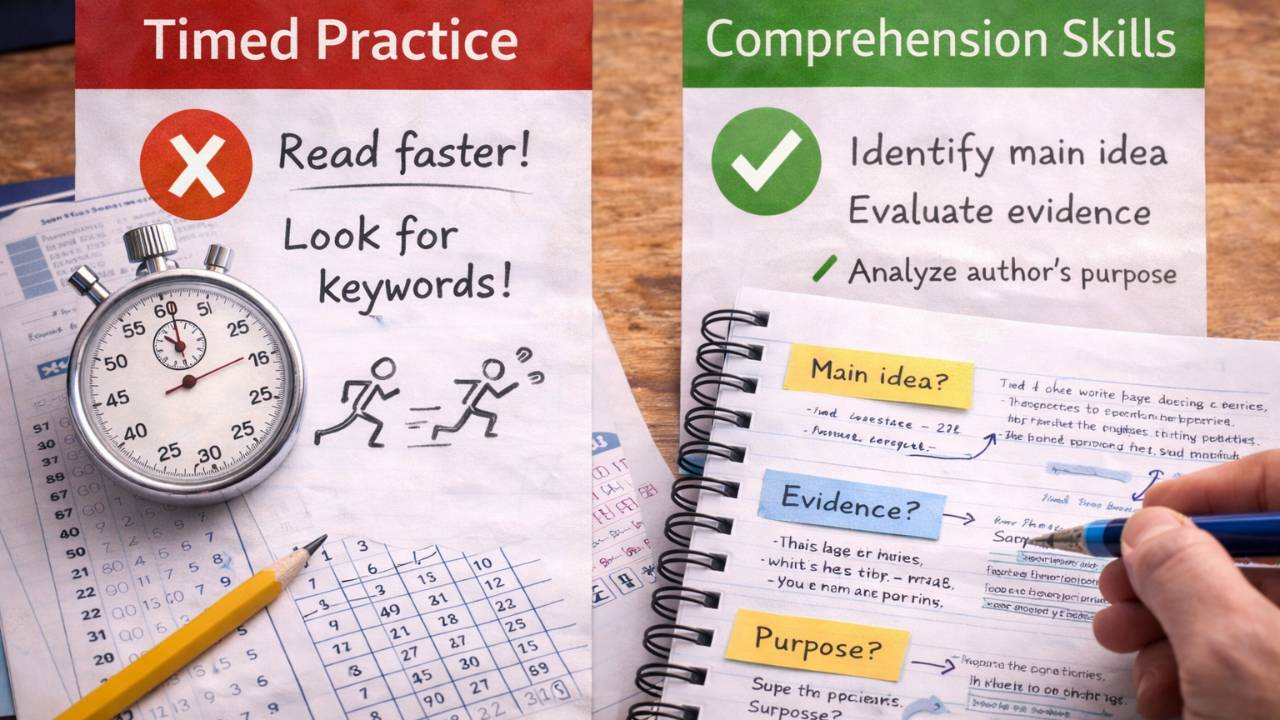
Most SAT prep programs start with the same flawed premise: if students just practice reading passages faster, their scores will improve. This speed-first approach dominates the test prep industry, with countless programs promising to boost reading rates through timed drills and pacing strategies. Yet students who spend months racing through practice passages often see minimal score improvement, and many actually develop worse reading habits that persist long after test day.
The problem runs deeper than ineffective test preparation. When we prioritize speed over comprehension, we reinforce the exact cognitive patterns that undermine academic reading skills. Research in cognitive load theory demonstrates that rushing through complex texts without proper analytical frameworks actually impairs both immediate understanding and long-term retention. The students who show consistent SAT Reading improvement approach preparation differently: they build systematic comprehension skills first, then naturally develop appropriate pacing as their analytical abilities strengthen.
The Cognitive Science Behind Reading Comprehension
Reading comprehension operates through a delicate balance of cognitive processes that cannot be rushed without consequence. According to cognitive load theory, our working memory can only process between five and nine chunks of information simultaneously. When students attempt to read faster than their comprehension systems can handle, they exceed this cognitive capacity, leading to fragmented understanding and poor retention.
The research is clear on what actually drives comprehension improvement. Studies show that deliberate practice with specific comprehension strategies, including inferencing, self-explanation, and systematic question generation, produces far greater gains than speed-focused training. These strategies work because they help students build mental schemas that organize and connect information, reducing the cognitive load required to process new texts.
Consider what happens cognitively when a student encounters a complex SAT Reading passage about evolutionary biology or constitutional law. Without established frameworks for processing academic discourse, their working memory becomes overwhelmed trying to decode vocabulary, track arguments, parse syntax, and maintain focus simultaneously. Adding time pressure to this already taxing cognitive load doesn't improve performance; it typically causes students to default to superficial scanning rather than engaged analysis.
Why Speed Drills Create Bad Habits
When students practice under constant time pressure without first developing strong comprehension foundations, they unconsciously adopt survival strategies that work against deep understanding. These compensatory behaviors become ingrained through repetition, creating reading habits that persist across all academic contexts.
The most common maladaptive pattern involves selective attention to familiar elements while skipping challenging sections. Students learn to hunt for keywords that might appear in questions rather than following the logical development of ideas. They begin treating passages as collections of isolated facts rather than coherent arguments with internal structure. This fragmented approach might occasionally yield correct answers through lucky matches, but it prevents students from developing the analytical thinking skills that the SAT actually measures.
The Comprehension-Speed Paradox
Ironically, students who focus exclusively on reading speed often become slower readers over time. Without proper comprehension strategies, they frequently need to reread passages multiple times, searching for information they missed during their initial rushed pass. They spend excessive time second-guessing their understanding, toggling between passages and questions without confidence in their interpretation.
Strong readers, by contrast, move through texts efficiently because they process information systematically the first time. They recognize rhetorical patterns, anticipate structural elements, and build mental models while reading. This deeper initial processing actually saves time because it eliminates the need for repetitive scanning and reduces uncertainty when answering questions.
Building Analytical Frameworks First
Effective SAT Reading preparation begins with teaching students to recognize and analyze the structural patterns that appear across academic texts. Before any timed practice, students need explicit instruction in how authors construct arguments, develop themes, present evidence, and establish relationships between ideas.
This framework-first approach draws from research on schema theory, which shows that readers with well-developed mental models for different text types comprehend new passages more quickly and accurately. When students understand that scientific passages typically move from observation to hypothesis to evidence to conclusion, they can anticipate and track this progression even in unfamiliar content. Similarly, recognizing common patterns in historical arguments or literary analysis provides scaffolding that supports comprehension of complex ideas.
Structured Passage Analysis
The most successful SAT Reading instruction teaches students to approach passages systematically through structured analysis protocols. Rather than simply reading from beginning to end, students learn to identify the passage's primary purpose, map its organizational structure, track shifts in perspective or tone, and evaluate how evidence supports claims.
This analytical approach might initially seem slower than straight-through reading, but it builds the cognitive architecture necessary for efficient comprehension. Students develop what researchers call "metacognitive awareness," the ability to monitor and adjust their own understanding while reading. They learn to recognize when comprehension breaks down and apply specific strategies to repair understanding, rather than simply pushing forward and hoping context will clarify confusion.
The Role of Deliberate Practice in Reading Development
Cognitive science research consistently demonstrates that expertise develops through deliberate practice: focused, goal-directed activities with immediate feedback and progressive difficulty. This principle applies directly to SAT Reading preparation, where improvement comes from systematically practicing specific comprehension skills rather than repeatedly taking timed sections.
Effective deliberate practice for reading comprehension involves targeted work on discrete skills. Students might spend a session focusing exclusively on identifying author tone and purpose across various passage types. Another session might concentrate on distinguishing between explicit statements and implied meanings. A third might address the skill of synthesizing information across paired passages with contrasting viewpoints.
Each practice session should include immediate feedback that helps students understand not just whether their answer was correct, but why certain interpretations are more valid than others. This feedback loop allows students to refine their analytical processes and build increasingly sophisticated comprehension strategies.
Progressive Complexity Without Time Pressure
Research-backed reading instruction follows a careful progression from simpler to more complex texts, allowing students to consolidate skills before advancing. Initial work might involve shorter passages with clear organizational structures and familiar content. As students demonstrate mastery, instruction gradually introduces longer passages, more sophisticated arguments, ambiguous language, and unfamiliar academic domains.
Throughout this progression, time remains a secondary consideration. Students first need to demonstrate consistent comprehension accuracy without time constraints. Only after establishing reliable analytical processes should timed practice enter the curriculum, and even then, timing should be gradually introduced rather than immediately enforced at test pace.
Evidence-Based Alternatives to Speed Drills
The most effective SAT Reading preparation replaces repetitive speed drills with evidence-based instructional techniques that build lasting comprehension skills. These methods, grounded in decades of reading research, develop the cognitive capabilities that support both test performance and long-term academic success.
Annotation and Active Reading Strategies
Teaching students to annotate strategically while reading transforms passive consumption into active analysis. Effective annotation goes beyond simple underlining; it involves marking structural transitions, noting author claims versus evidence, identifying tone shifts, and recording questions or connections. This physical engagement with text maintains focus and creates a visual map that supports question answering.
Research shows that students who learn systematic annotation strategies demonstrate better comprehension and retention than those who read without marking texts. The key lies in teaching purposeful annotation that serves comprehension rather than busy work that clutters the page without adding meaning.
Vocabulary Development Through Context
While many programs treat vocabulary as a separate component requiring rote memorization, research demonstrates that contextual vocabulary learning produces superior retention and transfer. Students develop stronger word knowledge when they encounter terms repeatedly across varied contexts and learn to use structural analysis and context clues to determine meaning.
Effective SAT Reading instruction embeds vocabulary development within passage analysis, teaching students to recognize Latin and Greek roots, use parallel structure to infer meaning, and leverage context to disambiguate unfamiliar terms. This integrated approach builds the kind of flexible vocabulary knowledge that supports comprehension across academic disciplines.
Long-Term Academic Benefits Beyond Test Scores
When SAT Reading preparation focuses on building genuine comprehension skills rather than test-specific tricks, students develop capabilities that extend far beyond standardized testing. The analytical reading strategies, metacognitive awareness, and systematic thinking patterns transfer directly to college coursework and professional contexts.
Students who learn to identify argument structures and evaluate evidence in SAT passages apply these same skills when reading college textbooks, analyzing primary sources, or reviewing research literature. The ability to synthesize information across multiple texts, a skill developed through paired passage analysis, proves essential for research papers and literature reviews. The careful attention to author purpose and rhetorical strategies supports critical thinking across disciplines.
Perhaps most importantly, students who develop strong comprehension foundations through structured practice maintain their reading skills over time. Unlike test-specific strategies that fade quickly after the exam, genuine analytical abilities become part of students' permanent cognitive toolkit. They read more efficiently, retain more information, and engage more deeply with complex texts throughout their academic and professional careers.
Implementation in Structured Curriculum
Translating these evidence-based principles into practical instruction requires carefully sequenced curriculum that balances skill development with progressive challenge. Effective programs begin with diagnostic assessment to identify specific comprehension gaps, then provide targeted instruction that addresses individual needs while building toward mastery of all tested skills.
The curriculum should explicitly teach comprehension strategies through modeling and guided practice before expecting independent application. Teachers need to demonstrate how expert readers approach different passage types, thinking aloud to make invisible cognitive processes visible to students. Gradual release of responsibility allows students to internalize these strategies through supported practice before working independently.
Assessment throughout the program should focus on comprehension quality rather than speed metrics. Students benefit from detailed error analysis that helps them understand patterns in their misunderstandings and develop strategies for avoiding similar mistakes. This formative assessment approach treats errors as learning opportunities rather than failures, building student confidence alongside skill development.
Conclusion
The persistent myth that timed practice alone improves SAT Reading scores reflects a fundamental misunderstanding of how reading comprehension actually develops. Cognitive science research consistently demonstrates that comprehension improves through systematic skill building, structured analysis, and deliberate practice with feedback, not through repetitive speed drills that reinforce poor reading habits.
Students deserve SAT preparation that builds genuine academic skills rather than superficial test-taking tactics. When we prioritize comprehension frameworks, analytical strategies, and progressive skill development, we prepare students not just for a single test but for the complex reading demands of college and career. The students who benefit most from this approach are often those who have been underserved by traditional test prep, particularly those without extensive exposure to academic discourse outside of school.
The path forward requires reimagining SAT Reading preparation as an opportunity for meaningful skill development rather than a race against the clock. By grounding instruction in evidence-based practices and cognitive science principles, we can help students build the deep comprehension abilities that support both immediate test performance and long-term academic success.
Ready to Build Lasting Reading Skills?
If you're looking for SAT preparation that develops genuine comprehension abilities through research-backed methods, explore the structured curriculum and evidence-based resources available at Cosmic Prep. Our materials focus on building the analytical frameworks and systematic strategies that create lasting improvement in reading comprehension, not just temporary test performance.