
Why Structured Math Progressions Matter More Than Practice Tests
Mar 03, 2026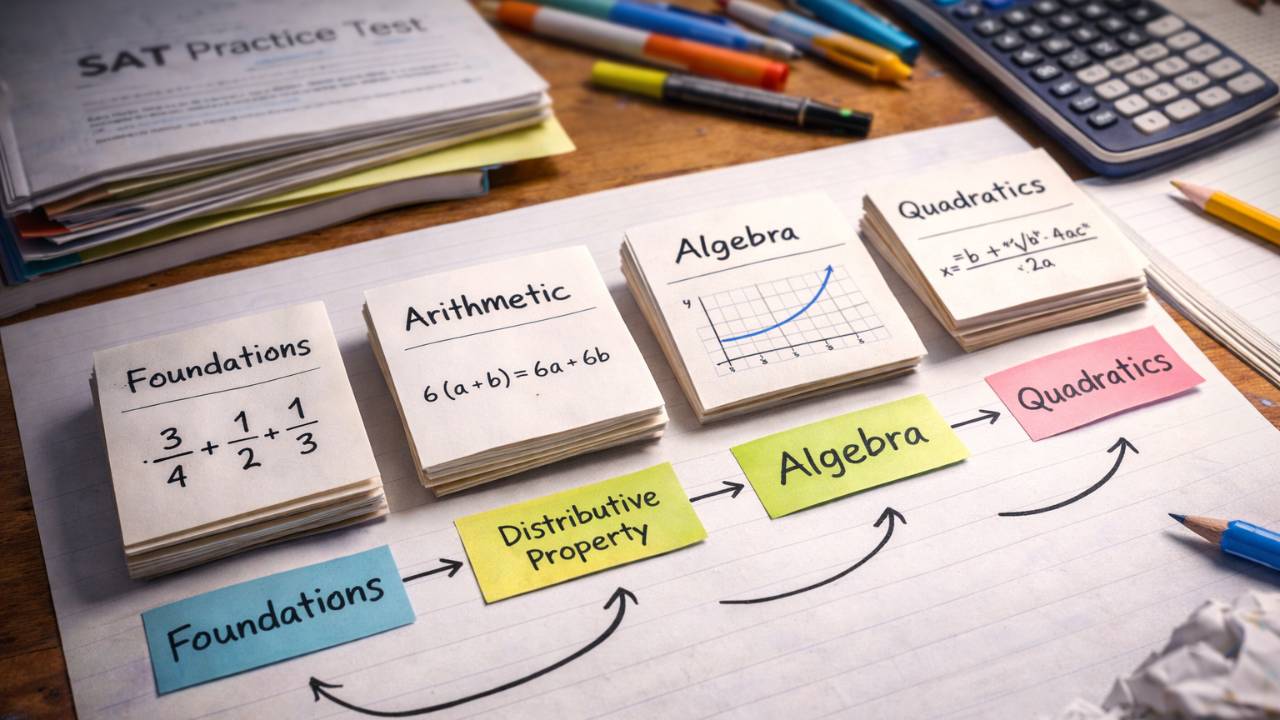
The SAT prep industry has convinced millions of students that success comes from grinding through practice tests. Take a test Saturday morning, review mistakes Sunday afternoon, repeat until scores improve. This approach feels productive because it generates data points and simulates test conditions. Yet decades of learning science research reveals a fundamental flaw: repetitive test-taking without systematic concept development produces shallow, temporary gains that evaporate under pressure.
The real path to mathematical competence on the SAT requires something less marketable but far more effective: structured progressions through interconnected mathematical concepts. When students build understanding systematically, moving from foundational arithmetic through advanced algebra with deliberate sequencing, they develop the kind of flexible problem-solving ability that persists beyond test day. This approach contradicts the test-prep orthodoxy of drilling question types and memorizing formulas, but it aligns with everything cognitive science tells us about how humans actually learn mathematics.
The Failure of Practice Test Dependency
Most commercial SAT prep programs center their curriculum around practice tests because tests are easy to administer and score. Students take a diagnostic test, identify weak areas, drill those question types, then take another test to measure improvement. This cycle continues until test day arrives. The approach appears logical and provides constant feedback through score reports.
But this test-centric model ignores how mathematical understanding actually develops. When students encounter a quadratic function problem on a practice test without first mastering linear relationships, factoring, and graphing fundamentals, they resort to pattern matching rather than genuine problem-solving. They might memorize that vertex form looks like this and standard form looks like that, but they lack the conceptual foundation to manipulate these forms flexibly when problems deviate from familiar templates.
Research on transfer learning demonstrates that skills developed through repetitive practice on similar problems rarely generalize to novel situations. Students who spend months drilling SAT-style quadratic problems often struggle when those same concepts appear in slightly different contexts. They have trained themselves to recognize surface features rather than understanding underlying mathematical structures. This explains why many students plateau after initial score gains from practice tests. They have exhausted the benefits of familiarization without developing deeper mathematical reasoning.
How Mathematical Understanding Actually Builds
Mathematics is fundamentally hierarchical. Each concept builds upon previous understanding in ways that cannot be shortcut through memorization or pattern recognition. The progression from arithmetic through algebra represents a carefully scaffolded journey where each step provides essential preparation for what follows.
Consider how understanding develops from basic operations through polynomial manipulation. Students first learn that multiplication represents repeated addition. This conceptual foundation enables them to understand exponents as repeated multiplication. From there, they can grasp why polynomial multiplication follows specific patterns and why factoring reverses this process. Each concept reinforces and extends previous understanding, creating a web of interconnected knowledge.
When the curriculum respects these natural progressions, students develop what researchers call "conceptual knowledge structures." These mental frameworks allow students to recognize deep similarities between superficially different problems. A student with strong conceptual structures sees the connection between factoring quadratics and finding x-intercepts because they understand both processes as different representations of the same mathematical relationship.
The Science of Sequenced Learning
Cognitive science research consistently demonstrates that how we sequence learning matters as much as what we teach. Two principles from learning science particularly apply to mathematics education: interleaving and spaced practice.
Interleaving involves mixing different problem types within practice sessions rather than blocking similar problems together. Traditional math textbooks typically present twenty factoring problems, then twenty graphing problems, then twenty word problems. This blocked practice feels easier because students know exactly what strategy to apply. But interleaved practice, where factoring, graphing, and word problems are mixed together, forces students to identify which approach each problem requires. This discrimination practice is exactly what students need on the SAT, where problems appear in random order without labels indicating which concept applies.
Spaced practice distributes learning across time rather than massing it together. Instead of spending three hours on quadratic functions in one session, an effective curriculum might spread that practice across several weeks, returning to quadratics periodically while introducing new concepts. This spacing creates what researchers call "desirable difficulties" that strengthen long-term retention. The effort required to retrieve previously learned concepts after a delay actually strengthens neural pathways more than immediate repetition.
Building Transferable Problem-Solving Skills
Structured progressions do more than teach specific mathematical concepts. They develop metacognitive skills that transfer across domains. When students learn mathematics through careful sequencing, they internalize problem-solving strategies that apply beyond the specific content.
A student who has progressed systematically through algebraic concepts develops pattern recognition abilities that extend to unfamiliar problems. They learn to identify mathematical structures regardless of surface features. This student sees that a word problem about compound interest and a question about exponential growth share the same underlying mathematics, even though the contexts differ completely.
This transfer happens because structured progressions teach students to think about relationships between concepts rather than treating each topic as isolated. They understand that linear equations, arithmetic sequences, and constant rate problems all involve the same fundamental concept of constant change. This connected understanding allows them to apply knowledge flexibly when encountering novel problems.
The SAT specifically tests this kind of flexible thinking. Problems often combine multiple concepts or present familiar ideas in unfamiliar contexts. Students who have learned through structured progressions possess the conceptual flexibility to decompose complex problems into manageable components. They can identify which mathematical tools apply and adapt their approach when initial strategies prove unsuccessful.
Why Retention Requires Systematic Development
The most overlooked aspect of SAT preparation is retention. Many students experience score regression between their final practice test and the actual SAT because their learning was superficial. Knowledge gained through cramming and repetitive drilling fades quickly without the reinforcement of genuine understanding.
Systematic concept development creates durable learning because it builds upon itself. When students understand why mathematical procedures work rather than just memorizing steps, they can reconstruct forgotten formulas from first principles. A student who understands the relationship between roots and factors can derive the quadratic formula if needed, while a student who merely memorized it might forget under test pressure.
This durability becomes especially important given the timeline of SAT preparation. Many students begin preparing months before their test date. Learning that depends on short-term memory and pattern recognition degrades over this timespan. But understanding built through structured progressions actually strengthens over time as students continue to encounter related concepts in their regular mathematics courses.
Implementing Progression-Based Learning
Creating effective mathematical progressions requires careful attention to prerequisite relationships and cognitive load. Each new concept should build naturally from established understanding while introducing manageable amounts of new information.
Start with diagnostic assessment that identifies conceptual gaps rather than just scoring performance. A student might correctly solve linear equations through memorized procedures while lacking understanding of what solutions represent graphically or contextually. These conceptual gaps must be addressed before progressing to more complex topics that depend on this foundation.
Design practice that deliberately sequences concepts to reinforce connections. Rather than isolated problem sets on individual topics, create mixed practice that requires students to identify relationships between concepts. Include problems that can be solved multiple ways, encouraging students to recognize when different approaches yield the same result.
Build a regular review that goes beyond repetition. Spiral back to previous concepts but in new contexts that deepen understanding. When introducing quadratic functions, reference how they extend ideas from linear functions. When teaching exponential relationships, contrast them with polynomial growth. These connections strengthen the conceptual network that supports flexible problem-solving.
The Long-Term Academic Benefits
The benefits of progression-based mathematics learning extend far beyond SAT scores. Students who develop genuine mathematical understanding through structured curriculum are better prepared for college-level mathematics and quantitative reasoning across disciplines.
College calculus assumes students possess not just procedural knowledge but conceptual understanding of algebraic relationships. Students who learned through systematic progressions can build upon their existing knowledge framework, while those who relied on memorization and pattern matching must essentially start over. This explains why many students who achieved high SAT math scores through test-prep tricks struggle in college mathematics courses.
Beyond specific mathematical content, structured progressions develop learning skills that transfer to other academic domains. Students learn how knowledge builds systematically, how to identify conceptual relationships, and how to construct understanding rather than memorizing information. These metacognitive skills support learning across all academic disciplines.
Moving Beyond Test-Prep Culture
The emphasis on practice tests and score improvement has distorted how we think about mathematics education. The SAT should be viewed not as an obstacle to overcome through clever strategies but as an opportunity to develop genuine mathematical competence that serves students throughout their academic careers.
This shift requires patience from students, parents, and educators accustomed to the immediate feedback of practice test scores. Building conceptual understanding through structured progressions takes time and often feels less productive than drilling practice problems. Students might not see dramatic score improvements in the first few weeks as they work through foundational concepts.
But this investment in systematic learning pays dividends that extend far beyond test day. Students develop confidence in their mathematical reasoning abilities rather than anxiety about remembering formulas and tricks. They approach unfamiliar problems with curiosity rather than panic because they trust their conceptual understanding to guide them toward solutions.
Explore Structured SAT Mathematics Curriculum
The path to mathematical competence requires more than practice tests and formula sheets. Students need a curriculum that respects the hierarchical nature of mathematics and builds understanding systematically. At Cosmic Prep, we've developed research-backed progressions that develop genuine mathematical reasoning rather than test-taking tricks. Our materials guide students through carefully sequenced concepts that build lasting understanding while preparing them for the specific challenges of SAT mathematics. Whether you're a student, parent, or educator, explore our approach to discover how structured learning can transform mathematical preparation from memorization into mastery.