
Why Spaced Repetition Beats SAT Cramming Every Time
Mar 03, 2026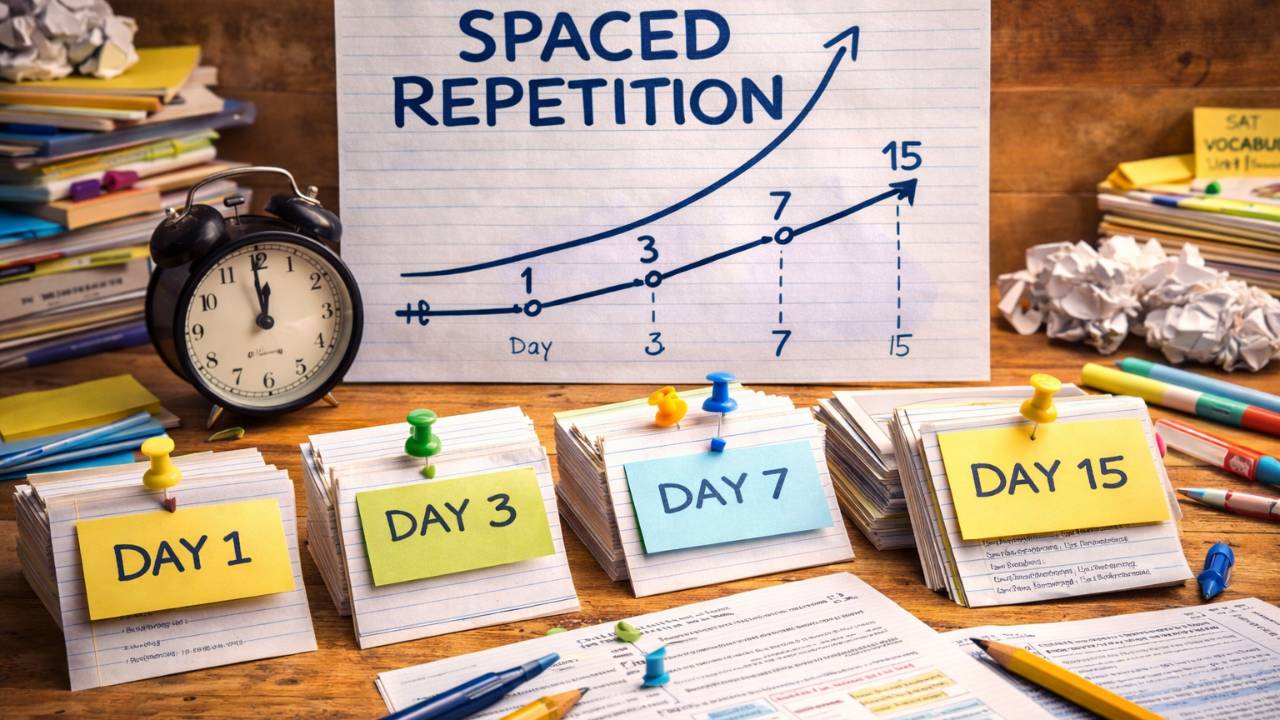
Most students approach SAT preparation with a fundamental misunderstanding about how learning actually works. They block out intensive study sessions the week before the test, convinced that concentrated effort will somehow translate into lasting comprehension. This approach reflects a broader misconception in test preparation: that the SAT rewards short-term memorization rather than genuine academic skill development. The research tells a different story. Decades of cognitive science demonstrate that distributed practice creates more durable learning than massed practice, and this principle applies directly to SAT preparation. The difference between students who retain their skills and those who forget everything after test day often comes down to whether they understood this basic principle of human cognition.
The traditional cramming model persists not because it works, but because it feels productive. Students experience the illusion of fluency during marathon study sessions, mistaking temporary familiarity for actual learning. They can solve similar problems in rapid succession, recognize patterns they just reviewed, and feel confident about their preparation. Yet this confidence evaporates under test conditions, where problems appear in unfamiliar contexts and require flexible application of concepts learned weeks or months earlier. The spacing effect, first documented in psychological research over a century ago and validated through hundreds of subsequent studies, offers a scientifically grounded alternative to this cycle of cramming and forgetting.
The Cognitive Architecture Behind Spaced Learning
Understanding why spaced repetition works requires examining how memory consolidation actually occurs in the brain. When students first encounter new information, whether a grammar rule or a mathematical concept, the initial encoding creates a fragile memory trace. Without reinforcement, this trace degrades rapidly according to the forgetting curve, a phenomenon first described by Hermann Ebbinghaus in 1885 and confirmed through modern neuroscience. Each time students retrieve information from memory, they interrupt this forgetting process and strengthen the neural pathways associated with that knowledge. The critical insight is that retrieval becomes more effective when it requires effort, which happens naturally when some forgetting has occurred between practice sessions.
The reconsolidation process that occurs during spaced practice fundamentally differs from the surface-level recognition that characterizes massed practice. When students review material after a delay, they must reconstruct their understanding rather than simply recognize familiar patterns. This reconstruction strengthens both the memory itself and the retrieval routes to that memory, creating what cognitive scientists call elaborative processing. For SAT preparation, this means that reviewing algebraic concepts after studying reading comprehension, then returning to algebra days later, produces stronger learning than working through algebra problems for hours straight.
Research from institutions including the University of California system and documented in publications from the American Psychological Association consistently shows that spaced practice can double the efficiency of massed practice for long-term retention. A meta-analysis examining 254 studies on the spacing effect found that students who distributed their practice over time retained 200% more information than those who studied the same material in concentrated blocks. These findings hold across diverse content areas, from vocabulary acquisition to mathematical problem-solving, making them directly applicable to the multifaceted demands of SAT preparation.
Why SAT Cramming Fails: The Transfer Problem
The SAT does not test memorized facts or rehearsed procedures. It assesses whether students can apply fundamental academic skills to novel problems under time pressure. This requirement for transfer, the ability to apply knowledge in new contexts, represents the fatal flaw in cramming-based preparation. When students engage in massed practice, they develop what researchers call context-dependent learning. They become proficient at solving problems that appear in a specific format or sequence but struggle when those same concepts appear in different configurations.
Consider how reading comprehension works on the SAT. Students must analyze unfamiliar passages across diverse subjects, from historical documents to scientific studies, and answer questions that require synthesis and inference rather than simple recall. Cramming might help students memorize question types or strategic approaches, but it cannot develop the underlying comprehension skills needed to process complex texts efficiently. These skills emerge through distributed practice with varied materials over time, allowing students to recognize patterns across different contexts and develop flexible reading strategies.
The adaptive nature of the digital SAT further amplifies the importance of deep, transferable learning. The test adjusts difficulty based on student performance, presenting harder questions to those who demonstrate initial proficiency. This adaptive mechanism rewards genuine understanding over test-taking tactics, as students cannot predict which concepts will appear or in what combinations. Spaced repetition naturally prepares students for this variability by exposing them to concepts in different contexts across multiple study sessions, building the cognitive flexibility the SAT demands.
Implementing Evidence-Based Spacing in SAT Preparation
Effective spaced repetition for SAT preparation requires more than simply spreading out study sessions. The optimal spacing interval depends on the retention interval, the time between the last practice session and the test itself. Research suggests that the ideal gap between practice sessions should be approximately 10-20% of the desired retention interval. For students preparing three months before their SAT, this translates to reviewing material every 9-18 days initially, with intervals adjusted based on mastery level.
The structure of spaced practice matters as much as the timing. Each practice session should involve active retrieval rather than passive review. Instead of rereading notes or watching solution videos, students should attempt problems without referring to examples, explain concepts in their own words, and test themselves on material from previous sessions. This retrieval practice, combined with appropriate spacing, creates what researchers call the testing effect, where the act of retrieving information strengthens memory more than additional study.
Interleaving different types of content within and across study sessions enhances the benefits of spaced repetition. Rather than dedicating entire sessions to grammar rules or geometry, students should mix problem types within each session. This interleaved practice forces the brain to continuously reload different solution strategies, strengthening the ability to recognize which approach applies to each problem. The College Board's own research supports this approach, showing that students who practice with mixed problem sets outperform those who study topics in isolation.
Building Long-Term Academic Skills Through Spaced Practice
The benefits of spaced repetition extend far beyond SAT performance. When students develop study habits based on distributed practice, they acquire metacognitive skills that serve them throughout their academic careers. They learn to plan their learning over extended periods, monitor their understanding across time, and recognize the difference between temporary familiarity and lasting comprehension. These self-regulation skills predict success in college coursework more strongly than standardized test scores alone.
Spaced repetition also addresses the equity issues inherent in test preparation. Students without access to expensive tutoring or test prep courses can implement spacing principles independently, using freely available materials from sources like Khan Academy. The technique requires no special resources beyond a calendar and discipline, making it accessible to any motivated student. This democratization of effective learning strategies aligns with broader efforts to ensure that SAT preparation enhances rather than undermines educational equity.
The cumulative nature of spaced practice creates compounding returns over time. Each review session not only maintains previous learning but also deepens understanding by revealing connections between concepts. Students begin to see how grammatical principles relate to reading comprehension, how algebraic reasoning supports geometric problem-solving, and how analytical skills transfer across disciplines. This integrated understanding represents the kind of academic maturity that predicts success in college-level work, where courses demand synthesis across multiple domains of knowledge.
The Institutional Shift Toward Spaced Learning
Educational institutions increasingly recognize the superiority of spaced repetition over traditional massed practice. Schools implementing distributed practice in their SAT preparation programs report not only improved test scores but also reduced student anxiety and increased confidence. When students experience consistent improvement over time rather than last-minute panic, they approach the test with genuine preparedness rather than desperate hope.
The shift toward spaced learning requires rethinking how we structure test preparation curricula. Instead of intensive boot camps or weekend workshops, effective programs distribute content across weeks or months, with built-in review cycles and progressive difficulty increases. This approach demands more planning and coordination but produces superior outcomes for student learning and retention. Tutoring companies and test prep providers who embrace these evidence-based methods distinguish themselves through student success rather than marketing promises.
Teachers and tutors play a crucial role in helping students implement spaced repetition effectively. They must resist student demands for immediate practice on recently taught material, instead guiding them toward review of previously covered concepts. This requires educating students and parents about the science of learning, helping them understand why struggle and effort during practice sessions signal effective learning rather than inadequacy.
Measuring Progress in Spaced Learning Systems
One challenge in implementing spaced repetition is that progress feels slower than with massed practice. Students accustomed to the rapid improvement that comes from concentrated practice may become discouraged when spaced practice produces more gradual gains. However, these gradual gains represent genuine learning rather than temporary performance improvements. Educators must help students recognize and value this distinction.
Effective assessment in spaced learning systems focuses on retention and transfer rather than immediate performance. Instead of testing students immediately after instruction, assessments should occur after delays that mirror the spacing intervals. This approach provides more accurate feedback about what students have actually learned versus what they temporarily memorized. Regular low-stakes testing distributed across the preparation period serves both as retrieval practice and as a progress monitoring tool.
The data from spaced practice reveals learning patterns that concentrated study obscures. Students discover which concepts require more frequent review, which skills transfer readily across contexts, and which areas need fundamental rework rather than surface review. This diagnostic information enables targeted intervention and personalized spacing schedules that optimize learning efficiency for individual students.
Transform Your SAT Preparation with Evidence-Based Methods
The research is unequivocal: spaced repetition produces superior learning outcomes compared to massed practice across every domain the SAT assesses. Students who distribute their practice over time, engage in active retrieval, and interleave different content types develop the deep, flexible understanding that the SAT rewards. More importantly, they acquire study skills and learning habits that serve them throughout their academic careers and beyond.
The choice between cramming and spaced repetition represents a choice between temporary performance and lasting learning. While cramming might produce short-term familiarity with test content, only distributed practice builds the transferable academic skills that enable success on test day and in college coursework. As the SAT continues to evolve toward assessing genuine academic readiness rather than test-taking ability, the advantages of spaced repetition will only become more pronounced.
For students, parents, and educators committed to meaningful SAT preparation, the path forward is clear. Embrace the science of learning, implement evidence-based spacing strategies, and focus on building academic skills rather than gaming the test. Explore the comprehensive, research-backed SAT preparation materials at Cosmic Prep to begin implementing these proven methods in your own learning journey. The investment in distributed practice pays dividends not just in test scores but in the development of lifelong learning capabilities that transcend any single assessment.