
Why Grammar Worksheets Fail SAT Writing Students
Mar 03, 2026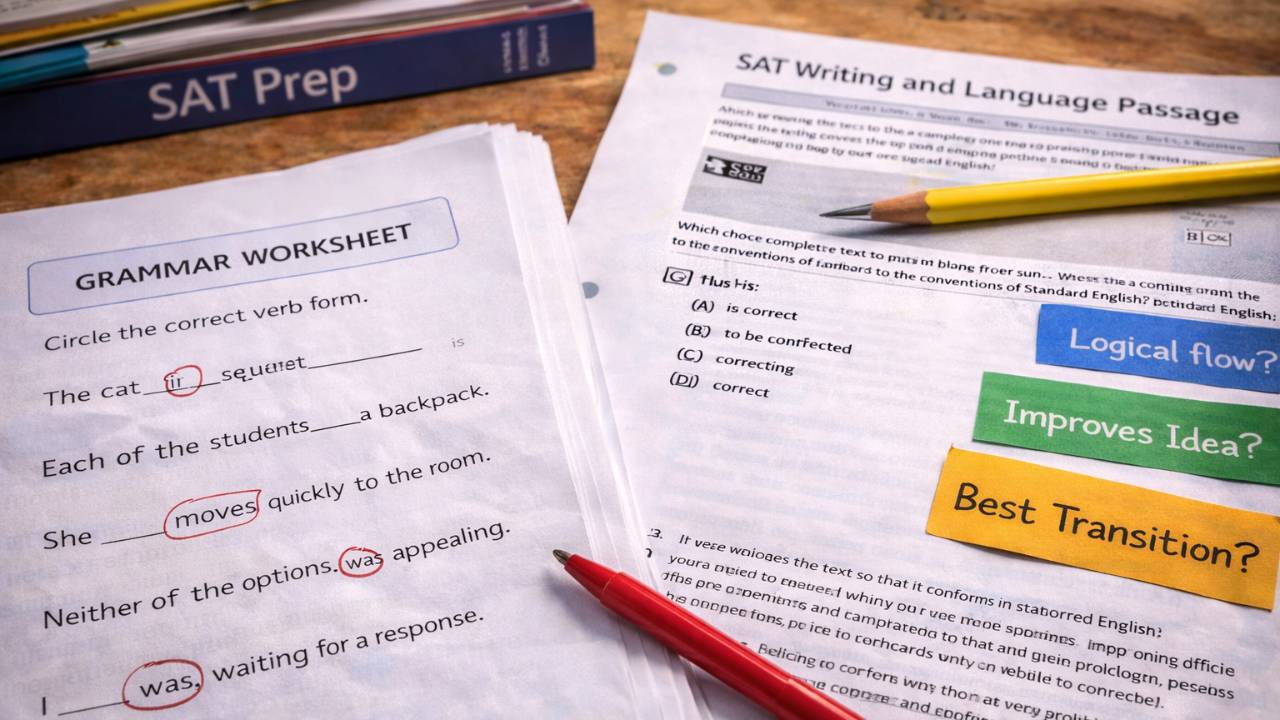
The stack of grammar worksheets on your desk represents decades of educational tradition. Subject-verb agreement drills. Comma splice exercises. Pronoun reference practice sheets. Yet when students encounter the SAT Writing and Language section, these isolated exercises often fail to translate into meaningful score improvements. The disconnect between traditional grammar instruction and actual SAT performance reveals a fundamental misunderstanding about how students develop the systematic language skills the test actually measures.
The failure of worksheet-based preparation becomes particularly evident when examining what the SAT Writing section actually tests. Rather than asking students to identify grammatical terms or recite rules in isolation, the test embeds grammar questions within authentic passages that demand contextual understanding. Students must navigate transitions between ideas, evaluate rhetorical choices, and maintain logical flow while applying grammatical conventions. This integrated assessment approach exposes the limitations of preparation methods that treat grammar as a collection of discrete rules rather than as a system for effective communication.
The Illusion of Mastery Through Isolated Practice
Traditional grammar worksheets create a dangerous illusion of competence. Students can achieve perfect scores on exercises focusing on singular grammatical concepts while remaining unable to apply those same concepts within complex passages. This phenomenon reflects what cognitive scientists call the "transfer problem" in learning. When students practice identifying comma splices in simplified, decontextualized sentences, they develop pattern recognition for that specific exercise format rather than building genuine understanding of how independent clauses function within actual writing.
The research on grammar instruction effectiveness consistently demonstrates this limitation. Studies spanning five decades show that isolated grammar drills produce minimal improvement in student writing quality. A student might correctly identify every instance of subject-verb disagreement on a worksheet yet fail to recognize the same error when it appears within a rhetorically complex SAT passage discussing scientific research or historical analysis. The cognitive load of processing meaning, structure, and grammar simultaneously overwhelms the superficial pattern recognition developed through worksheet practice.
This disconnect becomes particularly problematic given the adaptive nature of the digital SAT. Students who perform well on the first module encounter more sophisticated passages in the second module, where grammatical concepts interweave with complex rhetorical structures. Worksheet-trained students often experience a performance collapse when faced with these integrated challenges because their preparation never developed the cognitive flexibility to apply grammatical knowledge within authentic reading contexts.
Understanding Grammar as a System, Not Rules
Effective SAT Writing preparation requires reconceptualizing grammar as an interconnected system rather than a collection of independent rules. Consider how punctuation functions within the test. Rather than asking students to identify comma rules in isolation, the SAT presents passages where punctuation choices affect meaning, rhythm, and logical relationships between ideas. A single comma placement might determine whether a clause is restrictive or non-restrictive, fundamentally altering the passage's argument.
The three categories of Writing questions on the SAT—Vocabulary, Transitions, and Rhetorical Synthesis—explicitly test this systematic understanding. Transition questions require students to recognize logical relationships between sentences and paragraphs, selecting connecting words or phrases that maintain coherent flow. These questions cannot be answered through memorized transition word lists; they demand comprehension of how ideas relate to each other within specific argumentative or expository contexts.
Rhetorical Synthesis questions push this integration even further, asking students to combine or revise passages to achieve specific communicative goals. Success required simultaneous attention to grammatical correctness, stylistic consistency, and logical organization. Students must understand how grammatical choices serve rhetorical purposes, how sentence structure affects emphasis, and how punctuation guides reader interpretation. Worksheet practice that separates these elements fail to prepare students for their integrated application.
The Cognitive Science of Integrated Learning
Research in cognitive science explains why integrated grammar instruction produces superior retention and transfer compared to isolated practice. When students encounter grammatical concepts within meaningful contexts, multiple neural pathways activate simultaneously. They process semantic meaning, syntactic structure, and pragmatic purpose together, creating richer memory traces that facilitate retrieval and application in novel situations.
This integrated processing mirrors how humans naturally acquire language. Children do not learn their native language through explicit grammar rules but through exposure to meaningful communication where form and function intertwine. While adolescent learners benefit from some explicit instruction, that instruction proves most effective when embedded within authentic literacy tasks rather than isolated from actual language use.
The field notebook approach exemplifies this integrated methodology. Students select writers whose work genuinely engages them, then analyze how these writers employ grammatical structures to achieve specific effects. This practice develops metalinguistic awareness—the ability to think about language as a system—while maintaining connection to authentic communication. Students learn to recognize how professional writers use parallel structure for emphasis, vary sentence length for rhythm, or employ specific punctuation to control pacing.
Building Transferable Language Skills Through Structured Curriculum
Effective SAT Writing preparation requires carefully sequenced curriculum that builds systematic understanding over time. Rather than cycling through disconnected grammar topics, structured programs introduce concepts in relationship to each other, showing how parts of speech function within phrases, how phrases build into clauses, and how clauses combine to create sophisticated sentences that serve specific rhetorical purposes.
This curricular approach begins with foundational concepts but quickly moves to application within authentic texts. Students might start by understanding how modifiers function, then examine how professional writers use modifying phrases and clauses to add precision and nuance to their arguments. They analyze how modifier placement affects meaning and clarity, developing the judgment to recognize not just grammatical errors but stylistic weaknesses.
Vocabulary instruction within this framework moves beyond memorization to examine how word choice affects tone, precision, and rhetorical effectiveness. Students learn to recognize the subtle differences between related words, understanding how "analyze" differs from "examine" or "investigate" in specific contexts. This nuanced understanding proves essential for the SAT's Words in Context questions, which require selecting the most logical and precise word for a given passage.
The Role of Deliberate Practice in Skill Development
While isolated worksheets fail to build transferable skills, this does not mean practice is unimportant. The distinction lies between rote repetition and deliberate practice that progressively builds complexity and integration. Effective practice presents students with increasingly sophisticated passages that require simultaneous application of multiple grammatical and rhetorical concepts.
Consider a practice sequence for teaching punctuation. Rather than completing worksheets on comma rules, students might begin by analyzing how a published author uses commas to control pacing in a narrative passage. They then revise their own writing to achieve similar effects, receiving feedback on both correctness and effectiveness. Next, they examine how punctuation functions differently in argumentative versus expository texts, developing genre awareness alongside grammatical competence. Finally, they practice with SAT-style passages that require choosing punctuation to maintain logical flow and rhetorical consistency.
This progression from analysis to application to integration builds the cognitive flexibility students need for the SAT. They develop not just knowledge of rules but judgment about when and how to apply them. They learn to read like writers and write like readers, understanding how grammatical choices affect audience comprehension and response.
Addressing the Equity Dimension
The failure of worksheet-based instruction particularly disadvantages students from under-resourced schools who may lack exposure to sophisticated texts outside the classroom. When grammar instruction remains disconnected from authentic reading and writing, these students miss opportunities to develop the integrated language skills that more privileged peers might acquire through extensive reading and writing practice at home.
Structured, integrated curriculum can help level this playing field by ensuring all students receive explicit instruction in how grammar functions within authentic texts. Rather than assuming students will naturally transfer isolated grammar knowledge to their reading and writing, effective programs make these connections explicit and provide supported practice in applying grammatical concepts within meaningful contexts.
This approach also respects the linguistic diversity students bring to the classroom. Rather than treating Standard English as a set of arbitrary rules to memorize, integrated instruction helps students understand how different grammatical choices serve different communicative purposes in different contexts. Students develop code-switching abilities, understanding when and why to employ formal academic English while maintaining appreciation for the validity of their home languages and dialects.
Implications for Long-Term Academic Success
The skills developed through integrated grammar instruction extend far beyond SAT performance. Students who understand grammar as a system for effective communication are better prepared for college-level writing, where they must navigate different disciplinary conventions and rhetorical situations. They can analyze how scholarly writers in different fields construct arguments, adapting their own writing to meet varied academic expectations.
This systematic understanding also supports critical reading abilities. Students who recognize how writers use grammatical structures to emphasize certain ideas, establish logical relationships, or create specific tones become more sophisticated readers of complex texts. They can identify not just what an author argues but how grammatical and rhetorical choices shape that argument's effectiveness.
Perhaps most importantly, integrated grammar instruction develops metacognitive awareness about language and learning. Students learn to monitor their own writing processes, recognizing when sentences become unclear or arguments lose coherence. They develop revision strategies that go beyond surface error correction to address deeper issues of structure and flow. These self-regulatory skills prove essential for continued learning beyond formal education.
Moving Forward: Implementing Effective Grammar Instruction
Transforming grammar instruction requires fundamental shifts in how educators and test prep providers approach language learning. Programs must move beyond the worksheet model to create learning experiences that integrate grammatical concepts with authentic reading and writing tasks. This does not mean abandoning explicit instruction but rather embedding that instruction within meaningful contexts where students can immediately apply what they learn.
Technology can support this integration by providing adaptive practice that adjusts to student needs while maintaining connection to authentic texts. Digital platforms can present students with passages from varied disciplines and genres, helping them recognize how grammatical conventions function across different contexts. However, technology alone cannot solve the transfer problem; it must be paired with curriculum design that explicitly builds connections between form and function.
Assessment practices must also evolve to measure genuine language competence rather than isolated rule knowledge. Formative assessments should examine how students apply grammatical concepts within their own writing and how they analyze grammatical choices within published texts. This shift in assessment naturally drives instruction toward more integrated approaches.
Explore Evidence-Based SAT Preparation
The path to genuine SAT Writing success requires abandoning the comfortable familiarity of grammar worksheets in favor of integrated instruction that builds systematic language understanding. Students need a curriculum that treats grammar not as arbitrary rules to memorize but as tools for effective communication within authentic contexts. For educators and families seeking preparation materials that reflect these research-backed principles, Cosmic Prep offers a structured curriculum designed to develop the deep, transferable skills that lead to lasting academic success. Rather than promising shortcuts or tricks, these resources build the systematic understanding students need not just for the SAT but for the sophisticated reading and writing demands of college and beyond.