
Why Affordable SAT Prep Materials Shouldn't Mean Lower Quality
Mar 03, 2026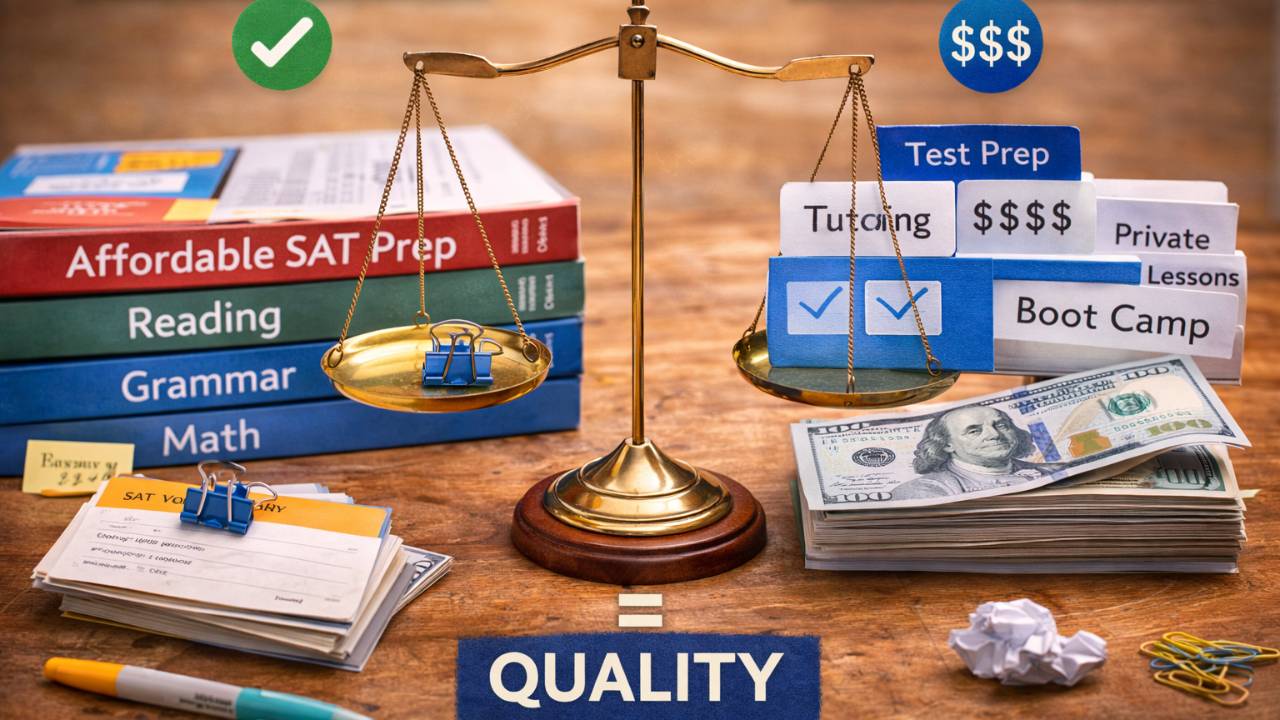
The prevailing assumption in SAT preparation is that quality correlates directly with price. Parents routinely spend thousands on premium tutoring packages, convinced that higher costs guarantee better outcomes. Meanwhile, students from lower-income families resign themselves to free resources that often lack structure, depth, or pedagogical rigor. This false dichotomy between affordability and quality represents one of the most damaging misconceptions in standardized test preparation. The truth is that effective SAT preparation depends not on price tags but on curriculum architecture, learning science principles, and systematic skill development. When we examine what actually drives student improvement on the SAT, we find that the most expensive programs often fail to deliver what matters most: transferable academic skills built through structured, evidence-based instruction.
The False Economy of Premium Pricing
The SAT preparation industry has conditioned families to believe that meaningful score improvement requires significant financial investment. This belief persists despite mounting evidence that many high-priced programs rely on the same surface-level strategies found in budget alternatives. The difference often lies not in educational substance but in packaging, marketing, and the psychological comfort that comes from spending more.
Consider what actually happens in many premium SAT programs. Students receive individualized attention, which certainly has value, but the underlying curriculum frequently emphasizes pattern recognition and test-taking tricks rather than genuine skill development. A student might learn to identify certain question types or memorize formulas without understanding the mathematical reasoning behind them. This approach may yield short-term gains, but it fails to build the foundational competencies that the SAT actually measures: critical reading, analytical reasoning, and mathematical problem-solving.
The College Board designed the current SAT specifically to resist such superficial preparation methods. The adaptive digital format, with its two-module structure per section, adjusts difficulty based on student performance, making it harder to game through memorization or tricks. Each Reading and Writing module contains 27 questions spanning multiple skill domains, while Math modules present 22 questions requiring genuine mathematical understanding. These questions demand real comprehension, not just pattern matching.
Understanding What Drives Real Learning
Research in cognitive science reveals that effective learning depends on specific instructional design principles, not financial investment. The spacing effect, documented extensively in educational psychology, shows that distributed practice over time produces superior retention compared to massed practice or cramming. Cognitive Load Theory demonstrates that learning improves when instruction manages the limited capacity of working memory through careful sequencing and scaffolding. Retrieval practice strengthens memory consolidation far more effectively than passive review.
These principles apply regardless of whether materials cost ten dollars or ten thousand. A well-designed curriculum that incorporates spaced repetition, manages cognitive load through chunking and scaffolding, and requires active retrieval will outperform an expensive program that ignores these fundamentals. The challenge is not creating effective materials at low cost but ensuring that affordable options actually implement research-backed instructional design.
Consider how this plays out in SAT Reading preparation. An effective curriculum breaks down the reading comprehension process into component skills: identifying main ideas, analyzing author purpose, evaluating evidence, and synthesizing information across texts. It then sequences these skills progressively, building from foundational to complex applications. Students practice retrieving and applying these skills across varied contexts, strengthening their ability to transfer learning to novel passages. This systematic approach works because it aligns with how the brain actually processes and retains information, not because it costs more to deliver.
The Architecture of Effective SAT Curriculum
Quality SAT preparation materials share certain structural characteristics that transcend price points. First, they treat the SAT as an assessment of academic skills rather than a puzzle to be solved. This means teaching students to read analytically, write precisely, and reason mathematically, not just to recognize question patterns.
Effective Reading and Writing preparation builds systematic comprehension strategies. Students learn to identify rhetorical structures, evaluate argumentative logic, and recognize the relationships between ideas. Grammar instruction moves beyond rule memorization to understanding how language choices affect meaning and clarity. These skills transfer directly to college coursework and professional communication, making SAT preparation an investment in long-term academic development rather than a temporary performance boost.
Mathematics preparation in quality programs emphasizes conceptual understanding over formula memorization. Students learn why mathematical procedures work, not just how to execute them. They practice translating word problems into mathematical models, recognizing when different approaches apply, and checking their reasoning for logical consistency. This depth of understanding enables flexible problem-solving across the varied question types that appear in SAT Math modules.
The sequencing of content matters as much as its selection. Effective curricula follow learning progressions that respect cognitive development and prerequisite relationships. Concepts build systematically, with each new skill reinforcing and extending previous learning. This careful architecture prevents cognitive overload while ensuring comprehensive coverage of tested domains.
Why Shallow Preparation Fails
The fundamental problem with both expensive and cheap test-prep shortcuts is their focus on performance mimicry rather than skill development. Students learn to produce correct answers without developing the underlying competencies those answers are meant to demonstrate. This approach fails for several reasons.
First, the adaptive nature of the digital SAT makes surface-level strategies less effective. When students perform well on the first module, they receive a more challenging second module that demands deeper understanding. Pattern recognition and memorized tricks break down when faced with novel problem presentations or complex reasoning tasks.
Second, shallow preparation produces fragile knowledge that degrades quickly. Students who cram test strategies might see temporary score improvements, but these gains evaporate without the conceptual foundation to support them. This explains why many students struggle to maintain or build upon initial score increases, regardless of how much they spend on preparation.
Third, and perhaps most importantly, shallow preparation wastes the opportunity for genuine academic growth. The skills the SAT measures, reading comprehension, grammatical precision, mathematical reasoning, and analytical thinking, form the foundation of college success. Students who develop these competencies through structured SAT preparation gain advantages that extend far beyond test day.
Building Equity Through Quality Design
The perpetuation of the price-quality myth in SAT preparation reinforces educational inequity. When families believe that only expensive programs deliver results, students from lower-income backgrounds face systematic disadvantages. This becomes a self-fulfilling prophecy when affordable options actually do lack quality, not because quality requires high costs but because the market has failed to demand rigor from budget alternatives.
Creating high-quality, affordable SAT preparation requires intentional design choices. Materials must be comprehensive enough to support independent learning while structured enough to prevent overwhelm. They need clear learning objectives, systematic skill progressions, and sufficient practice opportunities with detailed explanations. Digital delivery can reduce distribution costs while enabling adaptive features that personalize the learning experience.
The key is recognizing that instructional design expertise, not production expense, determines educational effectiveness. A carefully crafted curriculum that implements learning science principles will outperform a haphazardly assembled collection of practice problems, regardless of price point. This means investing in curriculum development, not marketing or premium packaging.
The Role of Structured Practice
Effective SAT preparation, whether expensive or affordable, must provide structured practice opportunities that promote skill transfer. This goes beyond simply offering practice tests or problem sets. Quality materials guide students through deliberate practice sequences that target specific competencies while gradually increasing complexity.
In Reading and Writing preparation, this might mean beginning with shorter passages that isolate specific comprehension skills, then progressively introducing longer texts that require skill integration. Students first practice identifying main ideas in straightforward expository passages, then apply this skill to more complex argumentative texts, and finally to paired passages requiring synthesis.
Mathematical skill development follows similar progressions. Students begin with foundational concepts presented in familiar contexts, then encounter variations that require flexible application. They learn to recognize underlying mathematical structures across different problem presentations, developing the adaptive expertise needed for the SAT's varied question formats.
Throughout this process, immediate feedback and detailed explanations help students understand not just what the correct answer is but why it is correct and how to arrive at it independently. This metacognitive awareness, understanding one's own thinking processes, proves crucial for continued improvement and skill transfer.
Measuring True Value
When evaluating SAT preparation materials, the relevant metric is not price but learning efficiency: how effectively do the materials help students develop transferable academic skills? This requires looking beyond marketing claims to examine curriculum structure, instructional design, and alignment with learning science principles.
Quality indicators include clear learning objectives mapped to SAT domains, systematic skill progressions with appropriate scaffolding, varied practice contexts that promote transfer, detailed explanations that build conceptual understanding, and regular assessment opportunities with actionable feedback. These features can be delivered at any price point through thoughtful design and efficient distribution.
The most expensive programs often add services like one-on-one tutoring or motivational coaching that may have value but do not fundamentally alter the curriculum's effectiveness. While personalized instruction can help, it cannot compensate for poorly designed materials or shallow instructional approaches. Conversely, well-designed self-study materials can produce excellent results when students engage with them systematically.
Affordable SAT preparation
The assumption that affordable SAT preparation means compromising on quality reflects market conditioning rather than educational reality. Effective test preparation depends on curriculum design, learning science implementation, and systematic skill development, none of which require premium pricing. When we recognize that the SAT measures genuine academic competencies rather than test-taking tricks, we understand that quality preparation means building these competencies through structured, evidence-based instruction.
The perpetuation of the price-quality myth serves neither students nor educational equity. It channels resources toward expensive programs that often fail to deliver meaningful skill development while discouraging investment in affordable alternatives that could provide superior educational value. By demanding rigor and evidence-based design from all SAT preparation materials, regardless of price point, we can ensure that quality instruction becomes accessible to all students, not just those who can afford premium programs.
The path forward requires reframing how we think about SAT preparation entirely. Rather than viewing it as a costly hurdle to overcome through tricks and shortcuts, we should recognize it as an opportunity for structured academic skill development. When preparation materials embrace this perspective, implementing research-backed instructional design and comprehensive curriculum architecture, they can deliver exceptional value at any price point. The question is not how much we spend but how wisely we invest in genuine learning.
Explore Evidence-Based SAT Preparation
For families and educators seeking affordable SAT preparation that maintains rigorous academic standards, exploring research-backed curricula can reveal options that prioritize skill development over test manipulation. Cosmic Prep offers comprehensive SAT Reading, Grammar, and Math materials designed around learning science principles, providing structured pathways to mastery without premium pricing. The focus remains on building transferable academic competencies that serve students well beyond test day.