
Why Prerequisite Mapping Prevents SAT Math Knowledge Gaps
Mar 27, 2026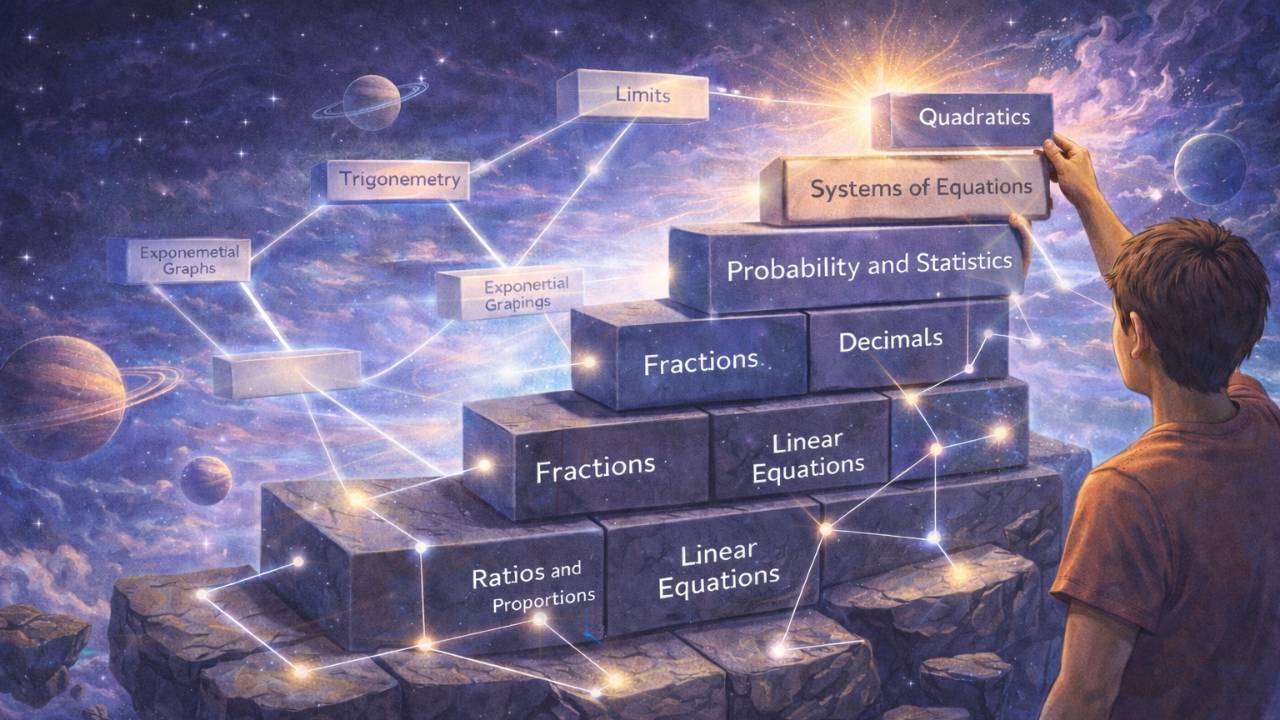
Most SAT prep programs treat math as a collection of discrete problem types to memorize. Students learn to recognize patterns in quadratic equations one week, then jump to probability the next, with no clear connection between topics. This fragmented approach creates a fundamental misunderstanding: that SAT math success comes from accumulating enough isolated techniques rather than building interconnected mathematical understanding.
The reality is that mathematical knowledge operates as a dependency network. Every algebraic manipulation, every geometric relationship, every statistical concept builds on specific prerequisite knowledge. When students attempt to learn advanced topics without mastering their prerequisites, they develop what appear to be random errors but are actually systematic failures rooted in foundational gaps. These gaps compound over time, creating increasingly unstable mathematical understanding that collapses under the pressure of unfamiliar problem variations.
The Architecture of Mathematical Dependencies
Mathematical concepts exist in strict hierarchical relationships. You cannot meaningfully understand systems of equations without first mastering single-variable equations. You cannot grasp quadratic functions without understanding linear functions. You cannot work with trigonometric ratios without solid geometry foundations. These are not arbitrary pedagogical choices but cognitive necessities dictated by how mathematical understanding develops in the human brain.
Consider a typical SAT problem involving the intersection of a parabola and a line. Surface-level prep might teach students to set the equations equal and solve. But this approach masks the prerequisite chain: understanding function notation, recognizing standard forms, manipulating algebraic expressions, applying the zero product property, and interpreting solutions in context. A student who memorizes the procedure without mastering each prerequisite will fail when the problem presents even slight variations.
This dependency structure aligns with what cognitive scientists call element interactivity. When students possess solid prerequisite knowledge, new concepts have lower intrinsic cognitive load because the foundational elements can be processed as unified chunks rather than separate pieces. Without prerequisites, students must simultaneously juggle unfamiliar foundational concepts while attempting to learn new material, overwhelming working memory and preventing meaningful learning.
How Knowledge Gaps Compound Into Systematic Errors
When students skip prerequisites, they develop compensatory strategies that appear to work in limited contexts but fail catastrophically when problems vary. A student who never mastered fraction operations might memorize cross-multiplication as a universal strategy. This works for simple proportion problems but fails when fractions appear in algebraic expressions, function transformations, or probability calculations.
These compensatory strategies create what learning scientists call buggy algorithms: systematic error patterns that persist because they occasionally produce correct answers. The student who always cross-multiplies when seeing fractions will sometimes get problems right by accident, reinforcing the misconception. Traditional test prep, focused on pattern recognition rather than conceptual understanding, often inadvertently strengthens these buggy algorithms by teaching shortcuts that work for specific problem types without addressing underlying gaps.
The compounding effect accelerates as students progress to more complex topics. A student with weak fraction skills will struggle with algebraic fractions, which undermines rational expressions, which prevents understanding of rational functions, which blocks comprehension of asymptotic behavior and limits. What began as a single gap in elementary mathematics becomes an insurmountable barrier to advanced topics.
Mapping Prerequisites Through Systematic Assessment
Effective prerequisite mapping begins with diagnostic assessment that traces errors to their foundational sources. When a student incorrectly solves a quadratic equation, the error might stem from the quadratic formula itself, from algebraic manipulation, from arithmetic with signed numbers, or from misunderstanding the equal sign. Each root cause requires different remediation.
Traditional diagnostic tests often fail because they assess at the wrong grain size. A test that simply identifies "weakness in algebra" provides no actionable information. Effective prerequisite mapping requires assessments that decompose complex skills into their constituent components and test each component separately. This granular approach reveals not just what students cannot do, but why they cannot do it.
The assessment must also distinguish between conceptual understanding and procedural fluency. A student might correctly apply the quadratic formula while holding fundamental misconceptions about what solutions represent. These conceptual gaps become critical when problems require interpretation or when students encounter non-standard forms. Prerequisite mapping must therefore assess both the ability to execute procedures and the understanding of underlying concepts.
Building Learning Sequences That Respect Dependencies
Once prerequisites are mapped, the curriculum must sequence topics to respect dependency relationships while maintaining engagement and momentum. This does not mean endless review of basics before touching advanced topics. Instead, it means introducing advanced concepts in scaffolded ways that simultaneously strengthen prerequisites and build new understanding.
Consider teaching systems of equations. Rather than assuming mastery of single-variable equations, begin with simple systems that can be solved by inspection, allowing students to see the relationship between solutions and graphs. Progress to substitution with integer solutions, reinforcing algebraic manipulation. Introduce elimination with carefully chosen coefficients that build fraction skills. Each step strengthens prerequisites while advancing toward the target skill.
This approach leverages what cognitive load researchers call the expertise reversal effect. As students develop mastery of prerequisites, instructional techniques must evolve. Worked examples that benefit novices become redundant for students with strong foundations. Prerequisite mapping allows instruction to adapt to each student's current knowledge state, providing support where foundations are weak while allowing rapid progress where prerequisites are solid.
The Compound Benefits of Sequential Mastery
When students learn mathematics through properly sequenced prerequisites, they develop more than just procedural skills. They build what cognitive scientists call schemas: organized knowledge structures that allow rapid pattern recognition and problem-solving. These schemas reduce cognitive load for familiar problem types, freeing mental resources for tackling novel variations.
Students with strong prerequisite foundations also develop mathematical intuition. They can estimate whether answers are reasonable, recognize when problems are similar despite surface differences, and adapt known methods to new situations. This flexibility is exactly what the SAT tests through its emphasis on problem-solving rather than rote calculation.
Perhaps most importantly, sequential mastery builds mathematical confidence based on genuine understanding rather than memorized tricks. Students who understand why mathematical procedures work can reconstruct forgotten formulas, verify their work, and approach unfamiliar problems systematically rather than guessing. This confidence translates directly to test performance, reducing anxiety and improving decision-making under time pressure.
Implementing Prerequisite-Based Learning in Practice
Creating prerequisite-mapped curriculum requires significant upfront investment in assessment design and content sequencing. Each topic must be analyzed for its dependencies, and multiple learning paths must be created to accommodate different starting points. This complexity explains why most test prep programs default to teaching isolated techniques rather than building systematic understanding.
Technology can facilitate prerequisite mapping by tracking student performance across multiple problems and identifying patterns in errors. However, technology alone is insufficient. Effective prerequisite mapping requires deep content knowledge to recognize which errors indicate which gaps and pedagogical expertise to design appropriate remediation.
The timeline for prerequisite-based learning often conflicts with test preparation schedules. Students and parents expect rapid score improvements, while building foundational understanding takes time. This tension must be addressed explicitly by demonstrating how prerequisite mastery leads to more reliable and substantial score gains than superficial pattern memorization.
Beyond Test Scores: Long-Term Academic Development
The benefits of prerequisite mapping extend far beyond SAT performance. Students who develop strong mathematical foundations through systematic prerequisite building are better prepared for college-level mathematics and quantitative coursework across disciplines. They possess not just specific skills but learning strategies for approaching complex hierarchical knowledge domains.
This approach also promotes equity in mathematics education. Students from under-resourced schools often have significant prerequisite gaps not from lack of ability but from inconsistent or incomplete instruction. Prerequisite mapping identifies and addresses these gaps systematically rather than assuming all students arrive with identical foundations. By making prerequisites explicit and providing targeted support, this approach gives all students access to advanced mathematical thinking.
The emphasis on understanding over memorization also better aligns with how mathematics is actually used in academic and professional contexts. Real-world problems rarely match textbook examples exactly. Success requires understanding principles deeply enough to adapt them to novel situations. Prerequisite-based learning develops exactly this kind of flexible, transferable mathematical knowledge.
Transform Your SAT Math Preparation
Rather than chasing shortcuts or memorizing formulas, consider how building mathematical understanding through careful prerequisite sequencing can transform both test performance and long-term academic success. Explore how Cosmic Prep designs a curriculum that respects mathematical dependencies, diagnoses foundational gaps, and builds genuine understanding from the ground up. Our SAT Math resources map the complete prerequisite network for every tested concept, ensuring students develop stable, transferable mathematical knowledge rather than fragile test-taking tricks.