
Building SAT Vocabulary Through Morphology Not Flashcard Lists
Mar 03, 2026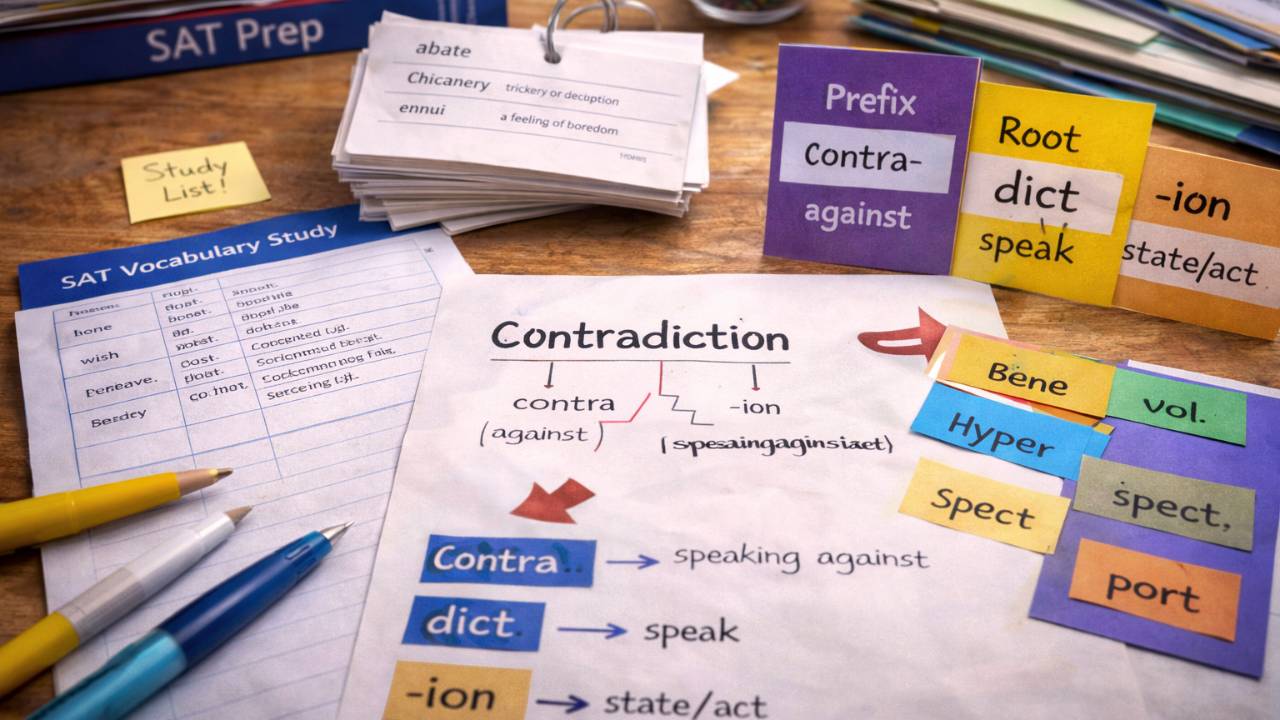
The typical SAT vocabulary preparation strategy looks like this: students receive a list of 500 "high-frequency" words, create flashcards, and attempt to memorize definitions through repetition. Three weeks later, they encounter an unfamiliar word on a practice test and freeze. The flashcard approach has failed them because it treats vocabulary as isolated data points rather than as a systematic, interconnected network of meaning. This fundamental misunderstanding of how vocabulary acquisition actually works explains why so many students struggle with the Words in Context questions that comprise a significant portion of the SAT Reading and Writing section.
The College Board tests vocabulary comprehension within the Craft and Structure domain, which accounts for approximately 28% of Reading and Writing questions. These questions require students to infer word meanings from surrounding passages, recognize nuanced connotations, and apply that knowledge to answer single-word or phrase-choice items. The test deliberately uses what they call "high-utility" words and phrases in context, not obscure vocabulary that students will never encounter again. This design choice reveals something crucial: the SAT rewards systematic understanding of how words work, not rote memorization of definitions.
The Science of Morphological Instruction
Morphology, the study of word structure and formation, offers a fundamentally different approach to vocabulary development. When students understand that words are constructed from meaningful parts rather than arbitrary letter combinations, they gain the ability to decode unfamiliar terms systematically. A student who recognizes that "contra" means "against," "dict" means "to speak," and the suffix "-ion" indicates an action or process can work out that "contradiction" involves speaking against something, even if they have never encountered the word before.
Research in elementary and secondary classrooms demonstrates that systematic morphological instruction produces measurable improvements in both vocabulary retention and reading comprehension scores. One documented case study showed that teaching one prefix, one suffix, and three root families each week, combined with daily mini-lessons and frequent word-construction exercises, led to significant retention of morphological knowledge and higher performance on standardized reading assessments. The students were not memorizing words; they were learning a system for understanding words.
The cognitive science behind this approach is straightforward. When we learn isolated facts through rote memorization, we store them in episodic memory, which is fragile and context-dependent. When we learn systematic patterns and relationships, we engage semantic memory, which creates durable, transferable knowledge structures. A student who memorizes that "benevolent" means "kind" has acquired one data point. A student who understands that "bene" means "good" and "volent" relates to "willing" has acquired a tool for decoding hundreds of words: benefactor, beneficial, benefit, benediction, benign, volunteer, malevolent, and countless others.
Building a Morphological Framework
Effective morphological instruction begins with the most productive word parts in academic English. Greek and Latin roots form the foundation of approximately 60% of English words and up to 90% of scientific and technical vocabulary. Rather than treating these as foreign language elements to memorize, students should understand them as the building blocks of meaning that operate consistently across thousands of words.
Consider the prefix "hyper," meaning "excessive" or "over." Students who understand this single morpheme can immediately grasp the core meaning of hyperactive, hypersensitive, hypercritical, hyperbole, hyperextend, and hyperventilate. They can also understand why "hypo," meaning "under" or "insufficient," creates opposite meanings in words like hypothermia, hypoglycemia, and hypothesis. This is not memorization; it is pattern recognition applied to language.
The most effective morphological curriculum introduces word parts systematically, not randomly. Start with the highest-frequency prefixes that account for the majority of prefixed words: un-, re-, in-, dis-, en-, non-, in-/im-, over-, mis-, sub-, pre-, inter-, fore-, de-, trans-, super-, semi-, anti-, mid-, and under-. These twenty prefixes alone appear in 97% of all prefixed words in printed school English. Teaching them systematically provides immediate, widespread utility.
Morphology in Practice: Beyond Simple Definitions
Understanding morphology transforms how students approach unfamiliar vocabulary in context. When encountering the word "circumspect" in a passage, a student trained in morphology recognizes "circum" (around) and "spect" (to look), inferring that the word relates to looking around carefully or being cautious. This inference, combined with context clues from the passage, leads to accurate comprehension without prior memorization of the specific word.
This approach particularly benefits students when dealing with academic vocabulary that appears across disciplines. The root "port," meaning "to carry," appears in transport, import, export, portable, portfolio, deportation, and report. Understanding this single root helps students navigate texts in science, social studies, literature, and technical subjects. The knowledge transfers because the morphological system remains consistent across contexts.
Teachers implementing morphological instruction report students spontaneously analyzing words they encounter in independent reading. One documented example describes a student questioning why a submarine is called a submarine, with another student responding that "marine means water and sub means under, so it's a thing that goes under water." This represents genuine comprehension and retention, not temporary memorization for a test.
Structured Implementation for SAT Preparation
For SAT preparation specifically, morphological instruction should focus on the word parts most likely to appear in academic texts and test passages. The College Board emphasizes high-utility vocabulary that students will encounter in college-level reading. This means prioritizing roots like "dict" (speak), "scrib/script" (write), "port" (carry), "ject" (throw), "tract" (pull), "vis/vid" (see), "mit/miss" (send), and "vert/vers" (turn).
A systematic approach might introduce three to five new roots per week, along with one prefix and one suffix. Each root should be taught with multiple example words, showing how meaning remains consistent across different contexts. Students should actively construct new words using known parts, predicting meanings before checking definitions. This word construction exercise, sometimes called "word math," reinforces the systematic nature of morphology.
Assessment should focus on application, not memorization. Rather than asking students to match roots to definitions, present unfamiliar words containing known morphemes and ask students to predict meanings. Provide passages with challenging vocabulary and ask students to use morphological analysis combined with context to determine meaning. This mirrors the actual task students face on the SAT.
The Transfer Effect: Beyond Test Preparation
The morphological approach to vocabulary development creates benefits that extend far beyond SAT performance. Students who understand word structure become more confident readers across all subjects. They develop strategies for tackling unfamiliar vocabulary in science textbooks, historical documents, and literary texts. They become word-conscious, noticing patterns and connections that deepen their understanding of language.
This transfer effect is particularly important for educational equity. Students from language-rich environments often acquire morphological awareness implicitly through extensive reading and exposure to academic vocabulary. Students without this advantage need explicit, systematic instruction to develop the same word-attack skills. Morphological instruction levels this playing field by making the hidden curriculum of vocabulary acquisition visible and teachable.
The approach also supports multilingual learners, many of whom speak languages with Latin or Greek influences. Spanish speakers, for instance, often recognize Latin roots that appear in both languages. Making these connections explicit accelerates vocabulary acquisition and validates students' linguistic resources.
Common Implementation Mistakes
Many well-intentioned attempts at morphological instruction fail because they treat word parts as just another list to memorize. Simply providing students with a chart of roots and definitions misses the point entirely. Effective morphological instruction requires active construction, analysis, and application. Students need to manipulate word parts, create new combinations, and test their predictions against actual usage.
Another common error involves teaching word parts in isolation from reading and writing. Morphological knowledge should be applied immediately to authentic texts. When students encounter a word like "intractable" in their reading, they should automatically parse it into "in" (not) and "tract" (pull or manage) and "able" (capable of being), understanding it as "not capable of being managed" or "stubborn." This real-time application reinforces the utility of morphological knowledge.
Teachers sometimes introduce too many word parts too quickly, overwhelming students with information they cannot meaningfully process. The goal is not to cover every possible root and affix but to deeply understand the most productive ones. Quality of understanding matters more than quantity of coverage.
Measuring Success Beyond Test Scores
While improved SAT scores provide one measure of success, the real victory of morphological instruction appears in students' changed relationship with language. Students who understand morphology read more confidently, tackle challenging texts more willingly, and express themselves more precisely in writing. They stop seeing unfamiliar words as obstacles and start seeing them as puzzles they have tools to solve.
Long-term retention provides another crucial metric. Students who memorize vocabulary lists for a test typically show steep forgetting curves, losing most of what they "learned" within weeks. Students who understand morphological patterns retain this knowledge because it is systematic and interconnected. They can reconstruct meanings even when specific definitions fade because they understand the underlying system.
The approach also changes how students prepare independently. Instead of creating hundreds of flashcards, they invest time in understanding productive patterns. They notice morphological connections in their regular reading. They become active constructors of meaning rather than passive recipients of definitions.
The flashcard approach
The flashcard approach to SAT vocabulary preparation represents a fundamental misunderstanding of how vocabulary acquisition works and what the SAT actually tests. The College Board designs vocabulary questions to assess students' ability to use systematic word knowledge and context to determine meaning, not to reward rote memorization of definitions. Morphological instruction aligns with this goal by teaching students to analyze word structure systematically, creating transferable skills that benefit them far beyond any single test.
The evidence from classroom implementation consistently shows that students who learn morphology outperform those who memorize lists, both in immediate assessment and long-term retention. More importantly, morphological instruction creates independent learners who can tackle unfamiliar vocabulary throughout their academic careers. This represents genuine college readiness, not just test preparation.
The choice between flashcards and morphology is really a choice between temporary test performance and lasting academic skill development. For educators committed to equity and evidence-based instruction, the decision should be clear. Teaching word structure systematically takes more initial investment than distributing vocabulary lists, but it creates readers and thinkers, not just test-takers.
Ready to Build Lasting Vocabulary Skills?
If you're ready to move beyond flashcard memorization and build systematic vocabulary knowledge that transfers to college-level reading, explore the morphology-based curriculum resources at Cosmic Prep. Our materials teach students to decode academic vocabulary systematically, creating confident readers who understand how words work, not just what they mean.